
US-Iran Peace Deal Becomes the Center of Global Attention as Diplomats, Investors and Governments Watch the Future of Middle East Stability
By Imperium Times Global Affairs Desk
In one of the most significant geopolitical developments of 2026, the reported framework surrounding a US-Iran Peace Deal has become the focal point of international diplomacy, financial markets, energy security discussions, and strategic policymaking across the world.
After months of military confrontation, regional instability, economic uncertainty, and growing concerns over global energy supplies, diplomatic efforts have produced what many observers describe as a potential turning point for the Middle East. Yet even as hopes for de-escalation rise, recent developments have demonstrated that peace remains a process rather than a guaranteed outcome.
The world is now watching closely as negotiations, implementation challenges, and regional security concerns determine whether the emerging US-Iran Peace Deal can evolve into a lasting framework for stability or become another missed opportunity in one of the most volatile regions on Earth.
Source: Imperium Times
US-Iran Peace Deal: A Turning Point in a Region Shaped by Conflict
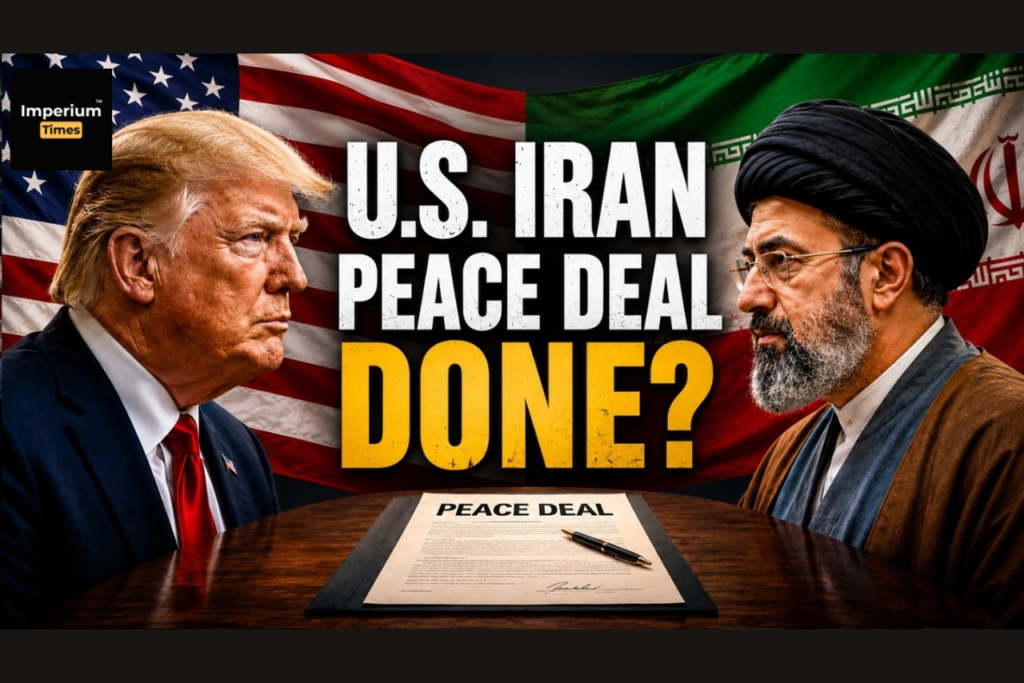
For decades, tensions between the United States and Iran have influenced global politics, energy markets, security alliances, and diplomatic strategies.
The latest phase of confrontation generated widespread concern among governments, businesses, investors, and citizens alike. Rising military activity, threats to shipping routes, and uncertainty surrounding regional security created a climate of heightened geopolitical risk.
Against this backdrop, diplomatic initiatives gained momentum as multiple stakeholders worked to reduce tensions and create conditions for dialogue. Reports of a framework agreement sparked optimism among global leaders who viewed negotiations as the most effective path toward long-term stability.
US-Iran Peace Deal: Why the World Is Closely Watching
The significance of the emerging US-Iran Peace Deal extends far beyond bilateral relations.
The Middle East remains one of the world’s most strategically important regions. Any shift in regional stability influences:
- Global oil prices
- International shipping routes
- Financial markets
- Defense strategies
- International trade
- Energy security
- Investment sentiment
This explains why developments involving Washington and Tehran are closely monitored by policymakers from Asia, Europe, Africa, and Latin America.
A durable peace framework could reshape economic and diplomatic dynamics across multiple continents.
The Strait of Hormuz Factor US-Iran Peace Deal
One of the most critical elements associated with negotiations has been the future status of the Strait of Hormuz.
The waterway represents one of the world’s most important energy corridors, carrying a substantial portion of global oil exports. Any disruption can immediately affect commodity markets and inflation expectations worldwide. Reports surrounding the agreement suggested renewed access and normalization of shipping activity through the strategic route.
The prospect of uninterrupted maritime traffic generated positive reactions among investors and energy markets, highlighting the enormous economic implications of regional stability.
US-Iran Peace Deal: Markets Respond to Diplomatic Momentum
Financial markets reacted strongly to indications that tensions might ease.
Investors generally reward predictability and stability. When geopolitical risks decline, market confidence often improves.
In the days following reports of progress, analysts observed reactions across:
- Equity markets
- Oil markets
- Currency markets
- Bond markets
- Precious metals
Lower perceived risk surrounding Middle East energy flows contributed to shifts in commodity pricing and investor expectations.
The response demonstrated how closely global markets remain connected to geopolitical developments.
Diplomacy Versus Military Escalation
One of the most important lessons emerging from recent events is the continuing value of diplomacy.
While military action can alter tactical realities, sustainable stability generally requires political agreements, communication channels, and long-term engagement.
The reported framework has reinforced the idea that dialogue remains an essential tool for conflict resolution.
Diplomatic initiatives are often complex, time-consuming, and politically challenging. Nevertheless, they frequently provide the only realistic pathway toward durable peace.
This principle remains central to the ongoing discussions surrounding the US-Iran Peace Deal.
US-Iran Peace Deal: Regional Reactions and International Expectations
Governments across the world have largely welcomed efforts aimed at reducing tensions.
Many nations view regional stability as essential for:
- Economic growth
- Energy affordability
- Trade continuity
- Investment confidence
- International cooperation
Several leaders publicly expressed optimism that negotiations could create opportunities for broader diplomatic engagement. International reactions reflected a common desire to prevent future escalation and encourage constructive dialogue.
At the same time, policymakers remain cautious, recognizing that implementation often proves more difficult than negotiation.
US-Iran Peace Deal: The Challenge of Building Lasting Trust
Peace agreements are rarely defined solely by signatures.
Their long-term success depends on trust, verification mechanisms, compliance structures, and sustained political commitment.
Historically, relations between Washington and Tehran have been characterized by periods of tension, disagreement, and mutual suspicion.
As a result, many observers believe the true test of the US-Iran Peace Deal lies not in its announcement but in its execution.
Questions remain regarding:
- Verification procedures
- Security guarantees
- Economic commitments
- Future negotiations
- Regional participation
Addressing these issues will be essential for building credibility and confidence.
Energy Markets and Economic Stability
One of the clearest economic consequences of diplomatic progress has been its influence on energy markets.
Oil prices are often highly sensitive to geopolitical developments. Even the possibility of improved stability can alter market expectations.
Reports indicating reduced disruption risks contributed to lower oil prices and improved sentiment among energy-importing nations.
For countries dependent on imported energy, sustained stability could help:
- Reduce inflationary pressures
- Support economic growth
- Improve fiscal planning
- Lower transportation costs
- Enhance business confidence
The economic benefits therefore extend well beyond the Middle East.
Why Investors Are Paying Attention
Global investors increasingly recognize geopolitical developments as major market drivers.
The emerging peace framework has influenced expectations across multiple sectors, including:
- Energy
- Aviation
- Shipping
- Manufacturing
- Infrastructure
- Technology
Reduced uncertainty often encourages investment activity because businesses can make long-term decisions with greater confidence.
The market response illustrates how international diplomacy and economic performance frequently intersect.
Obstacles Still Remain
Despite optimism, significant challenges remain.
Recent reports indicate that planned negotiations faced complications, creating questions about the pace and durability of implementation efforts. Continued tensions involving regional actors have also added uncertainty to the broader peace process.
These developments highlight an important reality:
Peace is rarely linear.
Progress often includes setbacks, disagreements, and periods of uncertainty.
Successful diplomacy requires patience, adaptability, and sustained engagement from all parties involved.
The Broader Strategic Importance
Beyond immediate security concerns, the emerging US-Iran Peace Deal carries broader strategic significance.
A stable Middle East could support:
- International trade expansion
- Infrastructure investment
- Energy market resilience
- Regional economic development
- Diplomatic cooperation
The agreement also serves as a reminder that even deeply entrenched conflicts can create opportunities for dialogue when political conditions align.
For many international observers, this represents one of the most encouraging aspects of the current process.
Implications for India and Emerging Economies
Countries such as India have a direct interest in developments across the Gulf region.
Energy security remains critical for economic growth, industrial development, and inflation management.
Improved stability could support:
- More predictable energy costs
- Stronger trade flows
- Enhanced investment opportunities
- Better supply-chain reliability
As one of the world’s fastest-growing major economies, India stands to benefit from a more stable regional environment.
This explains why developments connected to the peace process are being followed closely by policymakers and businesses alike.
A Defining Moment for International Diplomacy
The current situation represents more than a regional story.
It reflects the continuing importance of diplomacy in addressing complex international challenges.
The emerging US-Iran Peace Deal demonstrates that negotiation remains a viable alternative to prolonged confrontation.
While uncertainties persist, the willingness of stakeholders to pursue dialogue provides a foundation upon which future progress can be built.
Whether this effort ultimately produces lasting stability will depend on decisions made in the coming weeks and months.
Conclusion
The world has entered a critical period in which diplomacy, economic interests, and regional security are converging around one of the most important geopolitical developments of the year.
The evolving US-Iran Peace Deal has already influenced global markets, energy strategies, and international diplomacy. It has generated optimism, caution, and intense scrutiny in equal measure.
While challenges remain and implementation questions continue to emerge, the broader significance of the process is undeniable.
For governments, investors, businesses, and citizens worldwide, the outcome could shape geopolitical realities, energy security, and economic stability for years to come.
The coming chapters will determine whether this moment becomes a temporary pause in tensions or the beginning of a more stable era for the Middle East and the wider global economy.
Read More Articles Like This
at Imperium Times