
The race to build a lunar nuclear reactor has become one of the most consequential space stories of 2026. Recent reports reveal that the United States wants a lunar nuclear reactor operating on the Moon by 2030, while China and Russia are jointly targeting 2036 for their own lunar nuclear reactor. The contest is about far more than engineering. It is about who controls power, territory and influence at the Moon’s south pole, and it may decide who leads the next era of space exploration.
What Is the Lunar Nuclear Reactor Plan?
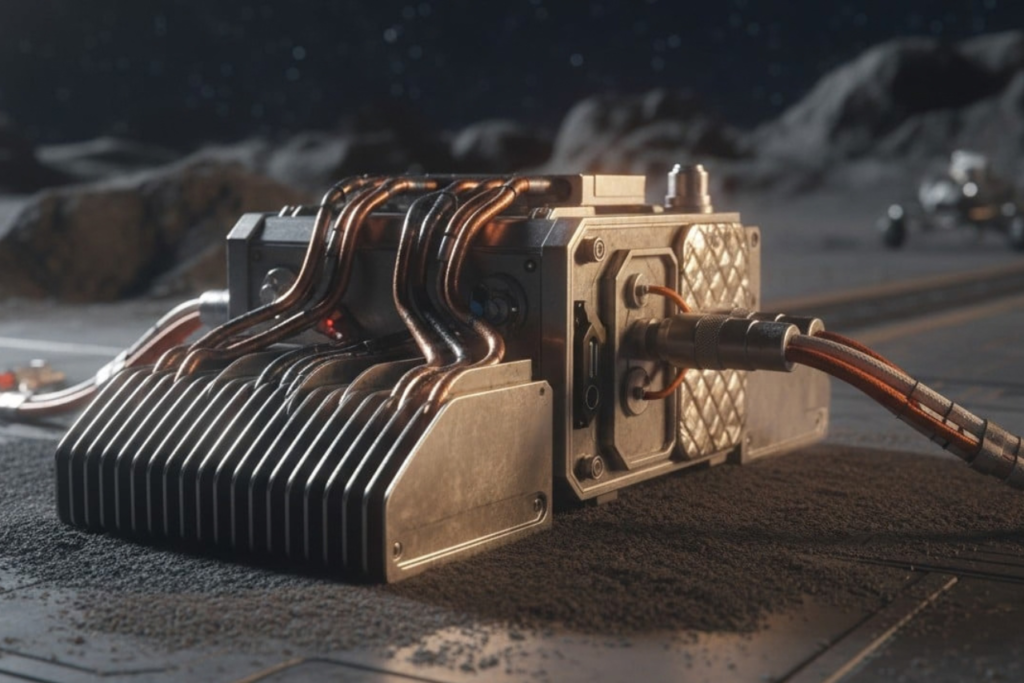
NASA’s concept is a fission-based lunar nuclear reactor that can run for years without maintenance near the Moon’s south pole. According to recent reports, the agency asked contractors to prepare a reactor that can survive the trip through space, with a launch deadline of December 2030. NASA’s interim administrator at the time, Sean Duffy, announced in August 2025 that the program would be fast-tracked, and the target output was raised to 100 kilowatts from an earlier 40 kilowatts. This lunar nuclear reactor is designed to power habitats, rovers, science equipment and, eventually, resource extraction.
The plan sits inside the Artemis program, which aims to establish a sustained American presence on the lunar surface. Without dependable electricity, no base can last. That is why the reactor has moved from a research idea to a central pillar of US lunar strategy.
Why the Moon Needs a Lunar Nuclear Reactor
The Moon’s night lasts roughly 14 Earth days, and some polar craters never see sunlight at all. Solar panels alone cannot supply steady energy under those conditions, and batteries large enough to bridge two weeks of darkness would be enormously heavy and costly to launch. A lunar nuclear reactor offers continuous output regardless of sunlight, temperature swings or location.
Engineers also point to efficiency. A compact reactor delivers a large amount of energy for very little mass, which matters when every kilogram sent to the Moon carries a steep price. For ice mining, oxygen production, communications and long-duration crewed missions, a reactor is widely seen as the most practical answer.
China and Russia’s Joint Lunar Nuclear Reactor Project
China and Russia agreed in May 2025 to cooperate on a lunar nuclear reactor to be completed by 2036. The reactor is meant to power the International Lunar Research Station (ILRS), the joint base the two countries plan to build near the Moon’s south pole. Reuters has reported that Wu Weiren, chief designer of China’s lunar exploration program, said Russia holds a natural advantage in space nuclear power, and that he hoped both nations could send a reactor to the Moon.
Russia’s space agency Roscosmos said in December 2025 that it planned a lunar power plant by 2036 and signed a contract with the Lavochkin Association to build it. The agency did not say the word nuclear explicitly, but it named Rosatom and the Kurchatov Institute as participants. Reports also refer to the Russia-China lunar nuclear reactor effort under the name Selena. For Moscow, the lunar nuclear reactor is a chance to apply decades of nuclear expertise. For Beijing, it is a way to pair its fast-growing lunar program, including the planned Chang’e-8 mission in 2028, with proven Russian reactor know-how.
US vs China vs Russia: Lunar Nuclear Reactor Timeline
The United States is aiming for a reactor of about 100 kilowatts by 2030, around the end of that year. China and Russia are aiming for a joint lunar nuclear reactor by 2036, with the broader ILRS basic model targeted around 2035. The six-year gap looks like an American advantage, yet it comes with a catch: the United States still lacks a final reactor design and firm plans for a permanent lunar base, according to analysis published by IEEE Spectrum.
The Keep-Out Zone Fear
The biggest strategic worry is territory. Duffy has warned that if China and Russia place a reactor first, they could declare a de facto keep-out zone, limiting where other nations can build. Under the Outer Space Treaty, no country can claim sovereignty over the Moon, but a safety perimeter around a working reactor could restrict access to the most valuable sites in practice. The south pole contains water ice, which can be turned into drinking water, oxygen and rocket fuel, so a single reactor could shape the geography of future lunar activity.
This is why officials describe the reactor contest as a race rather than a research project. The first nation to prove a working lunar nuclear reactor gains leverage in setting norms for safety zones, resource use and cooperation.
The Positive Side of the Lunar Nuclear Reactor Race
There are real benefits. Competition tends to speed up technology, and a successful lunar nuclear reactor could unlock permanent lunar stations, scientific discovery and the foundations for crewed Mars missions. Technology developed for this effort may also feed back into safer, smaller reactors on Earth, from remote communities to disaster zones.
Commercial opportunity is growing too. Reactor makers, launch providers, robotics firms and materials suppliers all stand to gain as governments fund the reactor supply chain. Europe is also active, with the Italian SELENE concept proposing a Moon Energy Hub built around small surface reactors.
The Negative Side: Risks, Cost and Geopolitics
The risks are equally clear. A rushed timeline can compromise safety, and critics argue that a 2030 deadline is aggressive when the design is not final. A launch failure involving nuclear material would trigger public alarm and diplomatic fallout. Questions remain over radiation shielding, heat rejection in a vacuum, remote assembly and what happens if debris or a meteoroid strikes a lunar nuclear reactor.
There is also the danger of militarization. Space analysts warn that a reactor race could harden rival blocs, with the United States and its Artemis partners on one side and China and Russia on the other. Without shared safety rules, every lunar nuclear reactor becomes both a power plant and a geopolitical signal.
Can the 2030 Deadline Be Met?
Experts quoted in coverage say the target is ambitious but technically possible. Fission power has been studied for decades, and NASA’s Fission Surface Power work provides a head start. Still, landing a heavy reactor, deploying it on uneven terrain and operating it autonomously is a complex job. Delays in the Artemis landers or in launch capacity could slip the reactor schedule. Many observers consider a staged approach more realistic: first a small demonstration unit, then scale-up.
What It Means for Investors and Industry
For business readers, the lunar nuclear reactor race signals long-term demand in space infrastructure, advanced nuclear fuel, high-temperature materials and heavy-lift launch services. Government contracts tied to a lunar nuclear reactor could support suppliers in the United States, Europe, Russia and China. Investors should treat the sector as long-horizon and policy-driven, since budgets and schedules can change quickly.
Lunar Nuclear Reactor FAQs
What is a lunar nuclear reactor?
A lunar nuclear reactor is a compact fission power system installed on the Moon’s surface to provide continuous electricity for bases, rovers and mining equipment.
When will the US launch a lunar nuclear reactor?
NASA’s target is 2030, with reports pointing to a December 2030 deadline and a capacity of about 100 kilowatts.
When will China and Russia build their lunar nuclear reactor?
The two countries are targeting 2036, to power the International Lunar Research Station.
Is a lunar nuclear reactor safe?
Designers say shielding and remote siting reduce risk, but launch safety and long-term operation remain key concerns.
Why not use solar power instead of a lunar nuclear reactor?
Lunar nights last about two weeks, so solar alone cannot support a permanent base. A reactor works day and night.
Final Word
The lunar nuclear reactor race is a defining test of technology, diplomacy and national ambition. If the United States reaches the Moon with a working reactor in 2030, it could set the standards others follow. If China and Russia deliver their lunar nuclear reactor in 2036 as planned, they will have built a rival power hub. Either way, the Moon is becoming a place where energy decides influence, and the world will be watching every milestone.
Read more Articles at Imperium Times