
By Imperium Times
The India AI Impact Summit, envisioned as a milestone event celebrating India’s rapid progress in artificial intelligence, took an unexpected turn after Galgotias University was reportedly asked to vacate the venue following controversy surrounding the display of a Chinese-made robotic dog. The incident has ignited debate across policy, technology and academic circles, raising larger questions about technology sourcing, national security and compliance standards in high-profile AI forums.
While the summit aimed to showcase innovation, startup acceleration and international collaboration, attention quickly shifted toward concerns about the origin of certain demonstration hardware. Sources indicated that the presence of a robotic canine device manufactured in China led to scrutiny, prompting organizers to act swiftly.
The episode places Galgotias University at the center of a broader national conversation about technological vigilance in an era where artificial intelligence intersects with strategic and security considerations.
What Happened at the India AI Impact Summit?
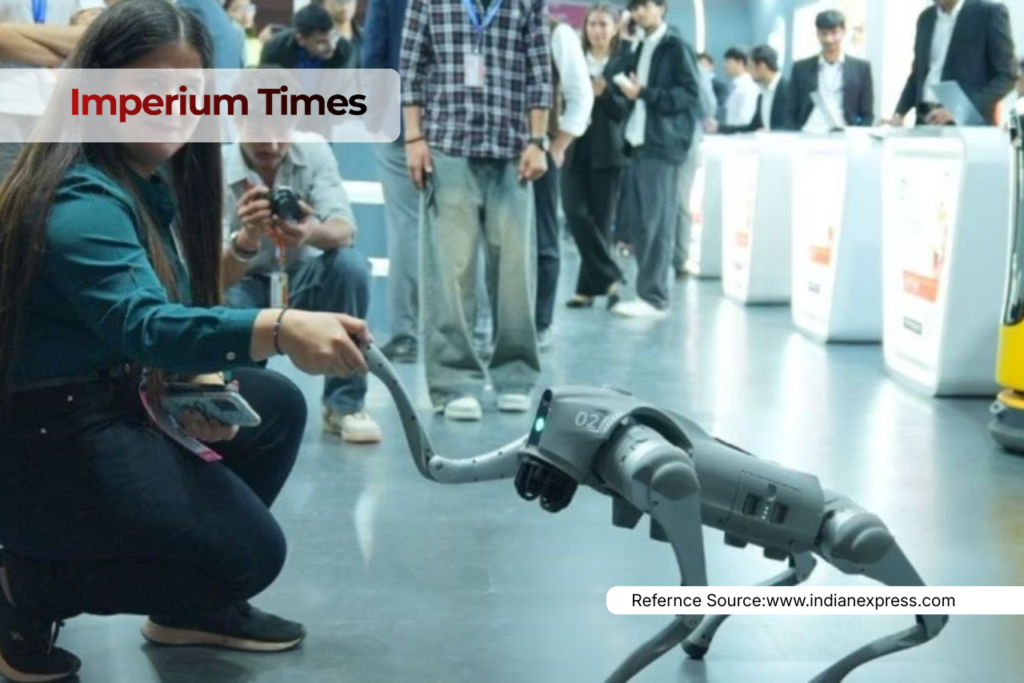
The India AI Impact Summit was designed as a platform bringing together policymakers, AI researchers, entrepreneurs and industry leaders to discuss advancements in generative AI, robotics, machine learning and semiconductor technologies.
However, during one of the demonstrations, a robotic dog reportedly sourced from a Chinese manufacturer drew attention from authorities. The device, often referred to as a “robodog,” has applications in robotics research, automation testing and AI experimentation.
According to sources, questions arose regarding procurement protocols and compliance procedures related to foreign hardware usage at the event. As scrutiny intensified, Galgotias University was asked to vacate its allocated space at the summit venue.
The decision reflects heightened sensitivity surrounding foreign technology imports, particularly from countries that feature prominently in geopolitical debates.
Why the Incident Matters Beyond One Institution
At first glance, the issue may appear limited to event logistics. Yet, experts argue that the implications extend far beyond a single university or demonstration device.
India has tightened regulations governing technology imports, especially in sectors related to telecommunications, data processing and advanced robotics. In such an environment, the presence of a Chinese-made robotic platform at a national AI summit becomes a symbolic flashpoint.
For Galgotias University, the controversy underscores the growing complexity of organizing AI exhibitions in a security-conscious climate.
Policy analysts note that AI systems often rely on integrated hardware and software ecosystems, which can carry embedded firmware or network connectivity components. Even seemingly benign devices may attract scrutiny under evolving compliance frameworks.
National Security and AI Governance
Artificial intelligence is no longer confined to academic experimentation or enterprise productivity tools. It now intersects with surveillance systems, defense applications and critical infrastructure management.
Against this backdrop, Indian authorities have adopted a cautious approach toward foreign technology integration. Experts believe the robodog row highlights the necessity of transparent vetting processes before hardware demonstrations at large-scale AI events.
The controversy surrounding Galgotias University may prompt clearer guidelines for future summits, ensuring alignment with national security standards while maintaining innovation momentum.
Academic Institutions in the Spotlight
Universities play a pivotal role in AI research and experimentation. Robotics platforms, including quadruped robotic systems, are widely used in research labs worldwide for testing mobility algorithms and autonomous navigation models.
However, the geopolitical landscape complicates academic collaboration. Institutions like Galgotias University must now navigate a regulatory framework that increasingly scrutinizes foreign-origin technologies.
Industry observers suggest that universities may need to enhance due diligence mechanisms, including supply chain transparency and compliance documentation, before participating in high-profile technology showcases.
Balancing Innovation and Sovereignty
India’s AI ecosystem thrives on global collaboration. Startups, multinational firms and research institutions frequently exchange ideas and technologies across borders.
Yet, policymakers face the challenge of safeguarding digital sovereignty while encouraging innovation. The incident involving Galgotias University illustrates how quickly this balance can tilt when security concerns emerge.
Maintaining openness to technological advancement while enforcing compliance standards will define India’s AI trajectory in the coming years.
Impact on the India AI Impact Summit
The summit itself aimed to highlight India’s ambition to become a global AI powerhouse. Key themes included generative AI adoption, semiconductor manufacturing expansion, startup incubation and digital infrastructure development.
While the controversy introduced temporary disruption, industry participants emphasized that India’s broader AI agenda remains unaffected.
Organizers are expected to revisit exhibition protocols to prevent similar disputes in future editions. The presence of academic institutions such as Galgotias University remains essential to fostering research-driven innovation.
Public and Industry Reactions
Reactions to the development have been mixed. Some stakeholders argue that heightened scrutiny is necessary in a geopolitically sensitive era. Others contend that excessive caution could hinder academic freedom and collaborative research.
For Galgotias University, the episode represents both a reputational challenge and an opportunity to demonstrate compliance transparency.
Technology policy experts emphasize that incidents like this should catalyze stronger frameworks rather than discourage innovation.
Broader Implications for Robotics in India
India’s robotics ecosystem is expanding rapidly, with startups and research labs developing indigenous robotic platforms. The robodog controversy may accelerate efforts to design and manufacture domestic alternatives.
Government initiatives supporting semiconductor fabrication and hardware production could reduce reliance on imported robotics components in the long term.
Institutions including Galgotias University may increasingly prioritize partnerships with domestic hardware developers to mitigate regulatory risks.
AI, Geopolitics and the Future
The intersection of AI and geopolitics has become unavoidable. As nations compete for technological leadership, regulatory oversight intensifies.
The situation involving Galgotias University serves as a reminder that AI innovation exists within a broader political and security context.
India’s policymakers are likely to refine procurement standards and compliance mechanisms, ensuring that innovation ecosystems remain secure and globally competitive.
Conclusion: A Turning Point in AI Event Governance
The India AI Impact Summit controversy reflects the growing complexities of organizing AI exhibitions in a rapidly evolving geopolitical landscape.
For Galgotias University, the episode underscores the importance of transparent procurement and compliance practices in high-visibility forums.
As India advances its AI ambitions, balancing openness with strategic vigilance will remain central to policy decisions. While the robodog row has sparked debate, it also offers an opportunity to strengthen governance frameworks that support both innovation and security.
Source: Reporting adapted from Hindustan Times.
Read more article like this!