
Three years ago, almost nobody outside a small circle of AI engineers had heard of Fluidstack. This week, the FluidStack founders became some of the youngest self-made billionaires in the world, after their AI data-center company closed a fresh funding round that values the business at eighteen billion dollars. The story of the FluidStack founders is fast becoming one of the defining business narratives of 2026, a tale of three young men from Oxford who spotted a gap that Google, Amazon and Microsoft could not fill fast enough, and built an empire on it.
The company, now headquartered in New York after relocating from London, has closed a one-point-five-billion-dollar private equity round led by Jane Street Capital, pushing its valuation to eighteen billion dollars. That leap has instantly transformed the FluidStack founders, Gary Wu, Jamie Cox and Cesar Maklary, into three of Europe’s youngest self-made billionaires, according to corporate filings that detail their shareholdings. For an industry obsessed with chips, the achievement of the FluidStack founders is even more remarkable because their company does not own a single GPU.
How the FluidStack Founders Built an Empire From an Oxford Dorm Room
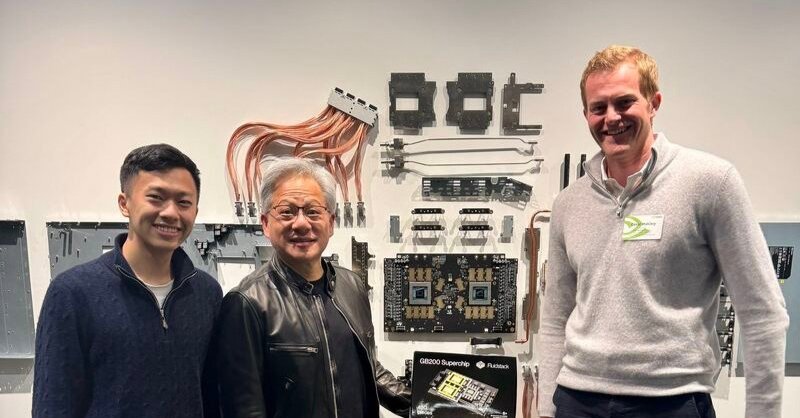
The origin story of the FluidStack founders reads like classic startup folklore. Jamie Cox was studying classics at Oxford University when he met Gary Wu, an economics student on the same campus. The pair founded Fluidstack in 2017 with a modest idea: pool underused graphics processing units sitting idle in data centers and research labs, then rent that spare capacity to developers who could not otherwise access it, an arrangement often described as an “Airbnb for GPUs.” Cox later dropped out of Oxford and became a Thiel Fellow, doubling down on the venture that would eventually make the FluidStack founders household names in the technology industry.
For years, the company remained a niche player. Revenue was just one-point-eight million dollars in 2022, a rounding error compared to the giants of cloud computing. But the FluidStack founders had built something the market did not yet appreciate: infrastructure that could scale the moment demand arrived. When ChatGPT triggered an explosion in global AI usage in late 2022, that moment came almost overnight. Marketplace-style GPU sharing was no longer enough for frontier AI labs hungry for dedicated, custom-built compute, so the FluidStack founders pivoted their entire business model, transforming Fluidstack into what the industry now calls a full-stack neocloud.
The Fifty Billion Dollar Anthropic Deal That Changed Everything
The single biggest turning point for the FluidStack founders arrived in November last year, when Anthropic signed an agreement committing fifty billion dollars to building custom AI data centers with Fluidstack in Texas and New York. It remains one of the largest infrastructure contracts in technology history, and it gave Anthropic greater independence from its existing cloud partners, Amazon Web Services and Google Cloud. For the FluidStack founders, the deal was the ultimate validation. A company that had once struggled for recognition was suddenly building the backbone for one of the most valuable artificial intelligence companies on the planet.
What makes the rise of the FluidStack founders particularly striking is the unconventional model underpinning their company. Unlike rivals such as CoreWeave and Nebius, which have built multi-billion-dollar valuations by purchasing and renting out Nvidia hardware, Fluidstack constructs and operates the physical buildings, the power systems and the proprietary software, while customers such as Anthropic bring their own chips. The FluidStack founders essentially bet that owning the platform, rather than the silicon, would prove more valuable in the long run. So far, investors agree. The company’s own in-house operating system, known as Atlas OS, and its monitoring platform, Lighthouse, are both chip-agnostic, supporting Nvidia and AMD hardware equally, a positioning that the FluidStack founders describe as a strategic moat rather than a limitation.
Google’s Quiet but Critical Role in the Rise of the FluidStack Founders
Behind the scenes, Google has played an outsized role in the ascent of the FluidStack founders, acting less like a customer and more like a financial backstop. Through agreements with former cryptocurrency miners TeraWulf and Cipher Mining, both of which are converting old Bitcoin facilities into AI compute campuses, Google has guaranteed billions of dollars of Fluidstack’s lease obligations in exchange for equity stakes in those companies. At one New York site alone, Fluidstack has contracted roughly three hundred and sixty megawatts of capacity worth an estimated six-point-seven billion dollars in revenue, with Google backstopping a significant portion of that obligation. This arrangement has given the FluidStack founders financial firepower that few founders their age have ever commanded, while also tying their fortunes closely to Google’s broader ambitions to challenge Nvidia’s dominance in AI chips.
Jane Street’s decision to lead the new funding round is itself a signal of how seriously institutional capital now takes the FluidStack founders and their vision. The quantitative trading firm already holds a stake in Anthropic and recently signed a six-billion-dollar cloud agreement with CoreWeave, making its investment in Fluidstack the completion of a rare triangle: exposure to the AI model maker, the chip-owning neocloud, and now the chip-agnostic infrastructure builder that serves them both. Notably absent from the FluidStack founders’ cap table is Nvidia itself, which has invested heavily in rival neoclouds but has stayed away from Fluidstack, a gap widely read as a reflection of Fluidstack’s deliberately chip-neutral strategy.
The Positive Side: A Blueprint for a New Generation of Founders
For young entrepreneurs and investors watching from the sidelines, the story of the FluidStack founders offers a genuinely optimistic message. It shows that founders without a background in chip manufacturing, and without the balance sheet of a hyperscaler, can still command a central position in the artificial intelligence economy by focusing on speed, flexibility and customer trust. Revenue at the company is projected to reach six hundred and sixty million dollars this year, more than tripling from the previous year, an extraordinary growth curve that reinforces why investors are willing to bet so heavily on the judgment of the FluidStack founders. Their modular construction approach, which can bring a data center online in roughly six months rather than the industry standard of eighteen to thirty-six months, has become a genuine competitive advantage during a global scramble for AI computing capacity.
The Cautionary Side: Risks the FluidStack Founders Cannot Ignore
Yet the rapid rise of the FluidStack founders is not without serious risk. Roughly fifty billion dollars of the company’s long-term contracted revenue flows from a single customer relationship with Anthropic, an extraordinary concentration that leaves little room for error if that demand ever slows. Because Fluidstack does not own chips, it also has no hardware inventory to redeploy elsewhere as a hedge, unlike chip-owning competitors. Community opposition to new data center construction is intensifying nationwide, with watchdog groups reporting that dozens of major projects worth billions of dollars were blocked or delayed in the first quarter of this year alone. Executing a ten-site buildout across Texas and New York while managing permitting, power procurement and local resistance is a very different challenge from raising capital, and the true test for the FluidStack founders will not arrive until 2027 and 2028, when Anthropic’s first facilities are expected to be fully operational.
Analysts covering the neocloud sector note that the FluidStack founders are operating in an increasingly crowded field, with rivals such as Crusoe, Lambda and Firmus all raising enormous sums this year. Publicly traded competitors CoreWeave and Nebius already command tens of billions of dollars in market value, meaning the FluidStack founders must continue proving that a chip-neutral, infrastructure-first model can compete over the long term, not just during a single explosive funding cycle.
What Comes Next for the FluidStack Founders
For now, the momentum remains firmly with the FluidStack founders. Their company has moved from a two-person Oxford dorm-room idea to a cornerstone of America’s artificial intelligence infrastructure race in under a decade, backed by some of the most sophisticated investors in global finance and trusted by one of the world’s most closely watched AI labs. Whether the FluidStack founders can convert this financial windfall into a durable, decade-long infrastructure company, or whether customer concentration and construction risk eventually catch up with them, will shape not just their personal fortunes but the broader trajectory of the global race to build enough compute for artificial intelligence.
Source: Imperium Times