
From the Bombay High Court, Aurangabad Bench, to global climate forums and grassroots initiatives in Marathwada, Adv. Sangeeta Desarda represents a growing vision of law as an instrument of justice, institutional accountability, sustainability and community empowerment.
By Imperium Times Editorial Desk
Beyond the Courtroom: Rethinking What Law Can Achieve

In an era when professional identities are increasingly shaped by the ability to work across disciplines, Adv. Sangeeta Desarda represents a distinctive example of how legal expertise can extend beyond conventional courtroom practice.
A practicing advocate at the Bombay High Court, Aurangabad Bench, Adv. Sangeeta Desarda has built her professional journey around constitutional values, human rights, gender justice, public law, governance and access to justice. Yet her vision of law does not end with litigation. It increasingly connects legal practice with climate governance, economic structures, sustainable development and grassroots empowerment.
Practicing law since 2009, Adv. Sangeeta Desarda has developed an interdisciplinary perspective strengthened by an LLM in Constitutional Law and a Master’s degree in Economics. This academic combination enables her to examine legal questions alongside the economic and policy structures that influence people’s everyday lives.
Her work reflects a simple proposition: law can do more than settle disputes. It can protect rights, strengthen institutions, improve awareness and create conditions in which communities can participate more meaningfully in decisions affecting their lives.
That philosophy is visible across her courtroom practice, academic work, climate engagement and social-impact initiatives.
Adv. Sangeeta Desarda: From Maharashtra to the Bombay High Court
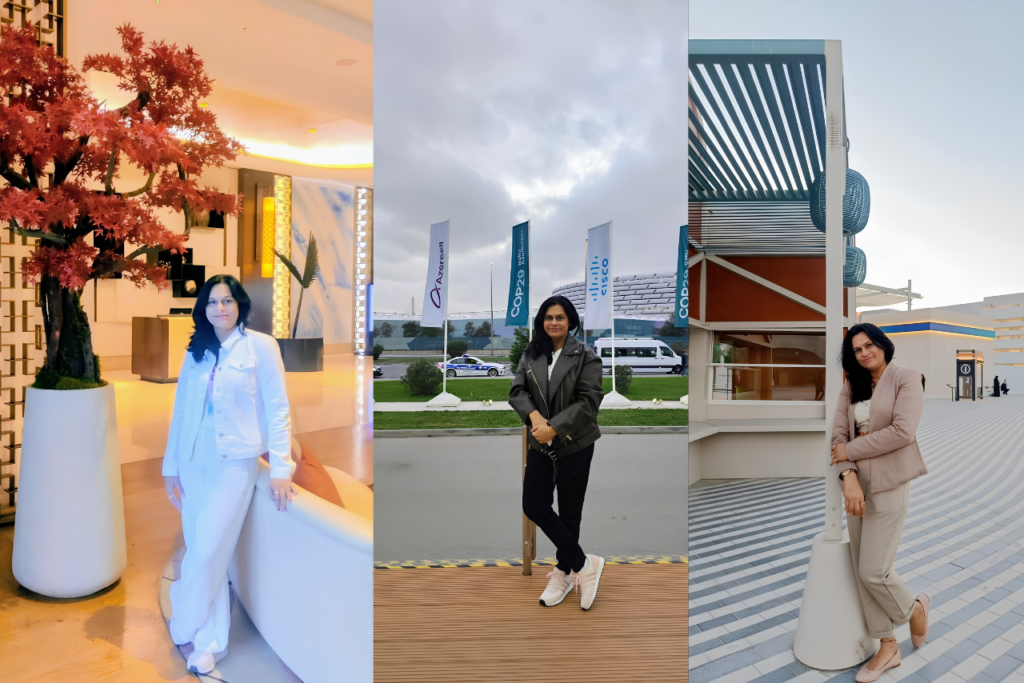
The professional journey of Adv. Sangeeta Desarda is rooted in Maharashtra, where early exposure to social and economic realities helped shape her understanding of public institutions, inequality and community concerns.
Her perspective was influenced by her father’s work as an economist and social worker and by early exposure to social movements associated with environmental and community voices such as Medha Patkar and Vandana Shiva.
These experiences contributed to an understanding that legal systems cannot be viewed independently from the communities they affect.
As a first-generation woman advocate, she also encountered the challenges that can accompany entering a traditionally demanding profession. Her journey included skepticism around whether law was suitable for women and questions surrounding the possibility of maintaining ethical standards in practice.
Her response was not confrontation for its own sake, but a sustained emphasis on preparation, integrity and professional consistency.
Over time, that approach helped establish her practice before the Bombay High Court, Aurangabad Bench, where her work encompasses constitutional matters, family law, criminal procedure, human rights and legal-aid-related concerns.
Source: Imperium Times
Constitutional Values at the Heart of Legal Practice
For Adv. Sangeeta Desarda, constitutional law is not merely an academic specialization. It provides a framework for understanding the relationship between citizens, institutions and the rights guaranteed within a democratic system.
Her professional interests encompass constitutional and public law, judicial review, family law, human rights, gender justice, economic offences and matters involving vulnerable communities.
This range demonstrates how legal practice can intersect with different aspects of social life.
Family disputes may involve questions of dignity and equality. Public-law matters can involve institutional accountability. Human-rights cases can bring questions of access and protection into focus. Economic offences can affect individuals, businesses and wider systems of trust.
The common thread is the relationship between law and lived reality.
Through this perspective, legal practice becomes a responsibility that extends beyond individual cases toward broader questions of fairness, institutional functioning and access to justice.
Where Law Meets Economics: An Interdisciplinary Perspective
The combination of constitutional law and economics gives Adv. Sangeeta Desarda an interdisciplinary foundation.
An LLM in Constitutional Law provides a detailed understanding of legal structures, rights, judicial interpretation and public institutions. Her Master’s degree in Economics adds another lens through which to examine policy, resources, markets and development.
This becomes particularly relevant when considering contemporary issues such as climate finance, sustainable agriculture and development inequality.
Environmental policy, for example, cannot be understood only through ecological science. It also involves financing, public policy, economic incentives, institutional responsibilities and questions of equity.
This interdisciplinary approach has increasingly shaped the academic and policy dimensions of her work.
It allows her to examine how legal frameworks interact with economic realities and how international commitments eventually affect communities at the local level.
From the Courtroom to the Global Climate Stage
The evolution of Adv. Sangeeta Desarda’s professional interests has taken her into an area that may initially appear distant from traditional legal practice: international climate governance.
She has participated in global climate and policy forums, including COP28 in Dubai and COP29 in Baku.
Her involvement reflects a growing interest in the legal, economic and institutional dimensions of climate change.
For her, climate change is not simply an environmental question.
It is connected to economics.
It is connected to governance.
It is connected to development.
And it is connected to justice.
Communities with fewer financial resources can face significant consequences from environmental disruption while having comparatively limited influence over international financial and policy structures.
That imbalance has informed her interest in climate finance and the implementation challenges surrounding international climate commitments.
Climate Finance Through a Global South Lens
The climate conversation frequently focuses on emissions, temperature targets and technological transitions. Yet another critical question concerns financing.
Developing countries require significant resources to adapt to climate impacts, strengthen resilience and transition toward more sustainable development models.
The academic and policy work associated with Adv. Sangeeta Desarda examines this broader dimension of climate governance.
Her research interests include climate finance, the New Collective Quantified Goal and the Loss and Damage Fund, with particular attention to implementation challenges emerging from international negotiations.
Her perspective is concerned with the gap that can exist between commitments announced at global forums and the practical mechanisms required to translate those commitments into meaningful action.
This focus brings questions of equity to the centre of climate policy.
For her, the climate debate becomes more meaningful when international commitments are examined through the experiences of communities and developing economies that must ultimately live with their consequences.
From Baku to Global Climate Policy: The COP29 Chapter
Her participation in COP29 in Baku, including through her engagement with the World Climate Foundation, represented another significant stage in her international engagement.
The experience placed her within a global policy environment where governments, researchers, civil-society organisations and other stakeholders debate the future of climate action.
Her involvement demonstrates how a legal professional from Aurangabad can participate in conversations extending far beyond conventional legal practice.
The significance is not simply geographical.
It reflects the possibility of connecting local realities with international policy discussions.
For Adv. Sangeeta Desarda, the challenge is to understand how international climate architecture can become more responsive to the economic and social conditions of communities across the Global South.
Building Institutions, Extending Impact
The social-impact dimension of Adv. Sangeeta Desarda’s work is reflected through two institutions: Arihant Law and Arihant Foundation.
As Co-Founder of Arihant Law, she has helped develop a legal practice focused on areas including human rights, family law, land acquisition and client-centred advocacy.
The philosophy behind the practice is to make legal support more approachable while retaining professional standards.
Alongside her legal practice, she serves as Founder and President of Arihant Foundation.
The Foundation extends this work into communities through initiatives focused on women’s empowerment, climate resilience, sustainable agriculture, youth outreach and legal literacy.
Together, the two institutions represent different but complementary forms of engagement.
One operates primarily through legal expertise.
The other seeks to build awareness, resilience and participation within communities.
Women as Architects of Community Resilience
One of the distinctive areas of the Arihant Foundation’s work is its emphasis on women-led community initiatives.
In drought-prone areas of Marathwada, the Foundation has worked around concepts including community seed banks, agro-ecology awareness, sustainable agriculture and legal literacy.
These initiatives reflect a broader understanding of empowerment.
For Adv. Sangeeta Desarda, women in rural communities should not be viewed simply as beneficiaries of development programmes. They can become decision-makers, knowledge holders and participants in building resilient local systems.
A community seed bank, for example, can connect agricultural knowledge with local resilience.
Legal literacy can help people understand rights and available institutional mechanisms.
Sustainable farming awareness can connect environmental responsibility with economic security.
The approach therefore links different forms of empowerment rather than treating each social challenge as an isolated issue.
Legal Literacy: Turning Awareness into Self-Reliance
Access to justice begins with awareness.
People cannot effectively exercise rights they do not know they possess.
This principle has informed the legal-literacy component of the Arihant Foundation’s work.
Legal awareness can be particularly important in communities where distance, limited resources or lack of information can create barriers between citizens and institutions.
Legal literacy does not mean turning every person into a legal expert. It means helping communities understand fundamental rights, available remedies and the institutions responsible for addressing particular concerns.
That knowledge can strengthen confidence.
It can also reduce dependence on informal systems when formal legal or administrative mechanisms are available.
In this sense, legal education becomes part of a larger strategy for self-reliance.
From Marathwada to Global Policy: Connecting the Local and the Global
Perhaps one of the most compelling aspects of Adv. Sangeeta Desarda’s professional profile is the relationship between her local and international work.
Her community initiatives engage with rural realities in Maharashtra.
Her legal practice operates within India’s judicial system.
Her academic work examines constitutional law and economics.
Her international engagement explores climate governance and finance.
These may initially appear to be separate activities.
But they are connected by a common concern: how institutions can serve people more effectively.
A drought-affected farmer, a woman seeking legal awareness and a developing country negotiating climate finance may exist within very different contexts.
Yet each raises questions about access, resources, representation, institutional responsibility and fairness.
This broader perspective helps explain why her work increasingly operates across multiple levels of governance and social impact.
Advancing Gender Justice, Human Rights and Dignity
Gender justice remains another important component of Adv. Sangeeta Desarda’s professional outlook.
Her legal practice and community initiatives reflect an emphasis on dignity, rights and access to justice.
Her approach to leadership also moves beyond professional designation.
Her philosophy is that leadership should be measured by the ability to create opportunities, strengthen institutions and leave systems better than they were found.
That philosophy is particularly relevant to gender justice because legal equality alone does not automatically guarantee equal access to opportunity.
Awareness, representation and institutional responsiveness also matter.
Through her legal and social-impact work, she contributes to a model of leadership in which professional expertise becomes a tool for creating wider participation.
Recognition That Reflects a Larger Journey
The growing profile of Adv. Sangeeta Desarda has also brought recognition from professional and leadership platforms.
Her honours include the Super Women Award 2025, Global Infinity Achiever 2025 and the 100 Women Icon Award.
She has also received media and professional visibility for her work across law, leadership, climate-related policy and social impact.
Yet recognition, in this narrative, occupies a broader place.
An award can acknowledge a journey, but it is not necessarily the final measure of achievement.
The greater measure lies in whether professional knowledge creates meaningful contribution.
Recognition may mark a milestone; the responsibility to continue contributing remains.
A New Model of Purpose-Driven Legal Leadership
In an era where leadership is often associated with visibility, Adv. Sangeeta Desarda’s professional identity reflects a more substantive model—one built across several connected systems.
The courtroom provides a platform for legal advocacy.
Arihant Law provides an institutional structure for professional practice.
Arihant Foundation provides a route into grassroots engagement.
Academic research creates space for deeper examination of policy questions.
International climate forums provide access to global conversations.
There is no single arena in which her professional identity is contained.
Instead, these dimensions reinforce one another.
The result is a model of leadership in which professional expertise is not confined to one institution or one field, but is applied across interconnected questions of law, governance, development and social impact.
Where Climate Justice Meets Sustainable Development
Climate resilience cannot be separated from development.
A community dealing with drought may simultaneously face agricultural, economic, educational and legal challenges.
Similarly, climate-finance decisions made internationally can influence the resources available for adaptation and resilience in developing regions.
This is why Adv. Sangeeta Desarda’s interest in climate governance extends naturally into sustainable development.
Her work seeks to connect global policy questions with local realities.
In Marathwada, that perspective can translate into community resilience, sustainable agriculture and legal literacy.
At international forums, it translates into discussions around climate finance, implementation and equity.
The two levels reinforce one another.
Global commitments become meaningful when they reach communities.
Local experiences become more powerful when they inform policy conversations.
The Road Ahead: Law, Climate Justice and Social Impact
The future direction of Adv. Sangeeta Desarda’s work lies increasingly at the intersection of law, public policy, climate justice and inclusive development.
The challenges ahead are complex.
Climate change is creating new governance questions. Economic inequality continues to influence access to opportunity. Communities require stronger legal awareness. Women need greater participation in decision-making. Institutions must remain accountable to the people they serve.
These challenges cannot always be addressed through one profession alone.
They require interdisciplinary thinking.
That is precisely where Adv. Sangeeta Desarda has chosen to position herself.
Her legal background provides an understanding of institutions and rights.
Her economics education provides an additional perspective on development and resource allocation.
Her social initiatives connect that knowledge to communities.
Her climate engagement extends the conversation internationally.
Redefining Legal Leadership Through Purpose and Impact
The professional journey of Adv. Sangeeta Desarda demonstrates how a lawyer can expand the definition of legal leadership.
Her work does not abandon the courtroom.
Instead, it extends the principles of justice beyond it.
Legal advocacy, community empowerment, climate policy and sustainable development become parts of a larger framework.
That framework is based on the belief that institutions work best when people understand them, participate in them and can hold them accountable.
Her work through Arihant Law and Arihant Foundation reflects this philosophy at different levels.
One focuses on legal practice.
The other focuses on community capacity.
Her climate-policy engagement adds an international dimension.
Together, they create a professional narrative that is both local and global.
Editorial Perspective: When Justice Becomes Public Infrastructure
The most compelling aspect of Adv. Sangeeta Desarda’s journey is the way she connects ideas that are often discussed separately.
Law is connected with human rights.
Human rights are connected with gender justice.
Gender justice is connected with community empowerment.
Community resilience is connected with climate change.
Climate action is connected with economics.
Economics is connected with governance.
And governance ultimately comes back to institutions and the people they serve.
This interconnected perspective gives her work its distinctive character.
From the Bombay High Court, Aurangabad Bench, to COP forums and grassroots initiatives in Marathwada, Adv. Sangeeta Desarda has developed a professional identity that moves between the courtroom, the classroom, the community and the international policy arena.
Her story is therefore not simply about becoming a successful advocate.
It is about asking what legal expertise can accomplish when it is combined with economic understanding, social responsibility and a willingness to engage with problems beyond traditional professional boundaries.
The answer is still evolving.
But the direction is clear: justice can be more than an outcome delivered after a dispute.
It can become knowledge.
It can become access.
It can become resilience.
And, when institutions are strengthened and communities are empowered, it can become a form of public infrastructure.
Read more article at Imperium Times.