
Washington, September 22, 2026 — In a moment that will likely be remembered as a turning point for American press freedom, the country’s five biggest television networks joined forces on Monday to protest the White House Press Ban imposed by President Donald Trump on three major news organisations. CNN, ABC, NBC, CBS and Fox News announced they would suspend the White House “pool” coverage that rotates among broadcasters, refusing to fill in for CNN after the network was formally excluded from the building because of the White House Press Ban. The extraordinary show of unity marks one of the most serious confrontations between the American press corps and a sitting president in decades, and the White House Press Ban has instantly become the biggest media story out of Washington this year.
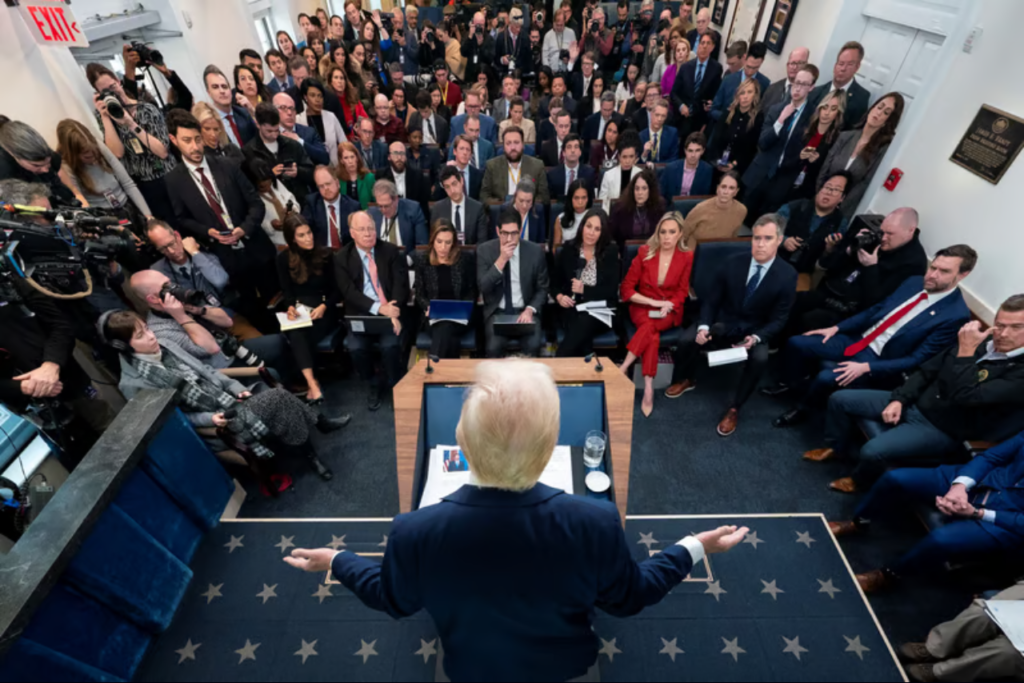
The controversy began on Friday when Trump announced on his Truth Social account that CNN, MS NOW and Politico would be barred, effective immediately, from covering the White House. The president accused the three outlets of spreading “Fake News” and said their reporting had damaged the country. By Monday, the White House Press Ban had escalated dramatically: CNN, which was scheduled to serve as the official TV pool broadcaster for the day, was removed from the rotation, and no replacement network was named. That left Trump’s high-profile events — including the ribbon-cutting for his new White House helipad and his scheduled address at the United Nations General Assembly in New York — without any live television coverage for the first time in memory, a direct consequence of the White House Press Ban now dominating headlines nationwide.
Why the Networks Took a Stand Against the White House Press Ban
Fox News Washington bureau chief Bryan Boughton, who currently chairs the pool rotation, informed fellow broadcasters that the TV pool would not cover any presidential events for the day, explaining that the decision stemmed directly from the administration’s move to sideline CNN under the White House Press Ban. In a rare joint statement, the five networks declared that the public has a vital interest in receiving accurate and independent information about its government, and that no administration should be allowed to punish a news organisation simply because it disagrees with that organisation’s coverage. The statement was seen by many media analysts as one of the strongest collective rebukes of a White House Press Ban ever issued by competing American broadcasters, who typically avoid taking joint political positions on matters involving their rivals.
The solidarity did not stop with television. Several leading photo agencies working out of the White House, including AFP, said they would delay releasing images of Trump’s public appearances in support of the outlets affected by the White House Press Ban. The Washington Post also confirmed that its photographers would withhold publication of presidential event photos until midnight, calling it a “collective effort” among newsroom photographers to stand behind CNN, MS NOW and Politico. This across-the-board pushback, spanning print, digital, and broadcast media, illustrates how seriously the American press views the implications of an unprecedented White House Press Ban that many argue tests the limits of the First Amendment and the broader principle of a free press.
Legal Battle Erupts Over the White House Press Ban
CNN, MS NOW and Politico did not merely protest; they went to court. The three organisations filed a federal lawsuit against Trump and several senior White House officials, arguing that the White House Press Ban violates their constitutional right to freedom of the press. Legal experts tracking the case say the lawsuit could set an important precedent on how far a presidential administration can go in selectively restricting media access based on the tone or content of coverage. Press freedom advocates have pointed out that a White House Press Ban targeting specific outlets over unfavourable reporting strikes at the very heart of the First Amendment’s protections, and several First Amendment scholars have already weighed in supporting the networks’ position against the White House Press Ban.
Trump, for his part, remained defiant. Writing on Truth Social, the 80-year-old Republican leader dismissed accusations that his administration was attacking press freedom through the White House Press Ban, insisting instead that he was targeting only “Fake News” that he claimed had grown “like Cancer” in the country. Vice President JD Vance, a former CNN commentator before entering politics, went further, accusing the banned outlets of spreading what he called “left-wing propaganda.” Vance argued that the affected journalists retained their right to report and their freedom of speech, but he insisted they no longer had a claim to office space or physical access inside the White House complex. Critics say this framing understates the practical impact of a White House Press Ban that effectively cuts a news organisation off from firsthand access to the president and his senior aides.
A Pattern of Media Restrictions Before This White House Press Ban
This is not the first time the current administration has clashed with the press corps. In February 2025, the White House imposed a similar restriction on the Associated Press after the wire service declined to adopt the administration’s preferred name for the Gulf of Mexico. That earlier dispute drew comparable outrage from press freedom groups and several news organisations, and it foreshadowed the far broader White House Press Ban now facing CNN, MS NOW and Politico. Observers note that each new restriction appears to escalate in scope, moving from a single outlet to three simultaneously, and now triggering a coordinated boycott from competitors who would normally have little incentive to defend a rival network caught up in a White House Press Ban.
In the absence of a functioning press pool, the White House has directed the public to livestream updates through its own official app, positioning it as an alternative viewing option for presidential events during the ongoing White House Press Ban. Communications experts warn that bypassing independent television coverage in favour of White House-controlled livestreams could set a troubling precedent, effectively allowing the administration to control the narrative around presidential activity without independent verification or follow-up questioning from working journalists. That concern lies at the core of why so many commentators view the ongoing White House Press Ban as more than a routine dispute between a president and reporters he dislikes, but rather a structural challenge to how the public receives information about its government.
Reactions From Media Watchdogs and Press Freedom Groups
Press freedom watchdog groups, including several based outside the United States, issued statements within hours of the boycott condemning the White House Press Ban as a dangerous escalation. Commentators pointed out that the coordinated response from five competing networks was itself remarkable, since broadcasters rarely align on anything beyond basic logistics. Analysts tracking global press freedom rankings said the White House Press Ban could influence how the United States is perceived internationally on matters of media independence, especially given Washington’s long-standing role as a vocal advocate for press freedom abroad. Some commentators have already begun drawing comparisons between this White House Press Ban and earlier disputes involving the Associated Press, suggesting a broader pattern rather than an isolated incident.
What This Means for Press Freedom Going Forward
Media historians say the events of the past few days may be looked back upon as a defining moment for how American journalism responds to political pressure. Never before have the country’s biggest broadcast rivals — outlets that compete fiercely for ratings and access — banded together so visibly to oppose a White House Press Ban. Whether the coordinated boycott forces a reversal from the administration, or whether it hardens into a prolonged standoff, will likely shape how future administrations approach press relations. For now, CNN, MS NOW and Politico await a court ruling on their lawsuit, while ABC, NBC, CBS and Fox News continue to hold firm in their refusal to provide pool coverage until the White House Press Ban is lifted.
The outcome of this standoff carries consequences well beyond Washington. International observers, including press freedom organisations, are closely watching how the world’s most powerful democracy handles an internal dispute over a White House Press Ban that many believe tests the boundaries of constitutionally protected journalism. As the legal case moves forward and public pressure mounts, the White House Press Ban is likely to remain one of the most closely followed political and media developments of the year, with implications for how access, accountability and free expression are balanced in the years ahead.
Source: Imperium Times