
Introduction: Snehanshu Manna – Where Skill Meets Industrial Reality
Location: Bankura & Durgapur, West Bengal
Sector: Technical Education | Industry 4.0 | Skill Development
India’s aspiration to emerge as a global manufacturing powerhouse depends not only on infrastructure or policy, but on the quality of human capital cultivated at the grassroots level. As industries transition rapidly toward automation, precision engineering, and digitally driven production systems, vocational education faces an urgent need for reinvention. Traditional models that once focused narrowly on machine operation are no longer sufficient in an era defined by Industry 4.0.
At Government Industrial Training Institute (ITI) Durgapur, a quiet yet powerful transformation has been underway—one that redefines how technical skills are taught, applied, and valued. At the center of this transformation is a methodology that bridges the long-standing gap between digital design and physical execution, creating technicians who are not merely operators, but thinkers, planners, and independent producers.
Snehanshu Manna: From Skill Training to Skill Architecture
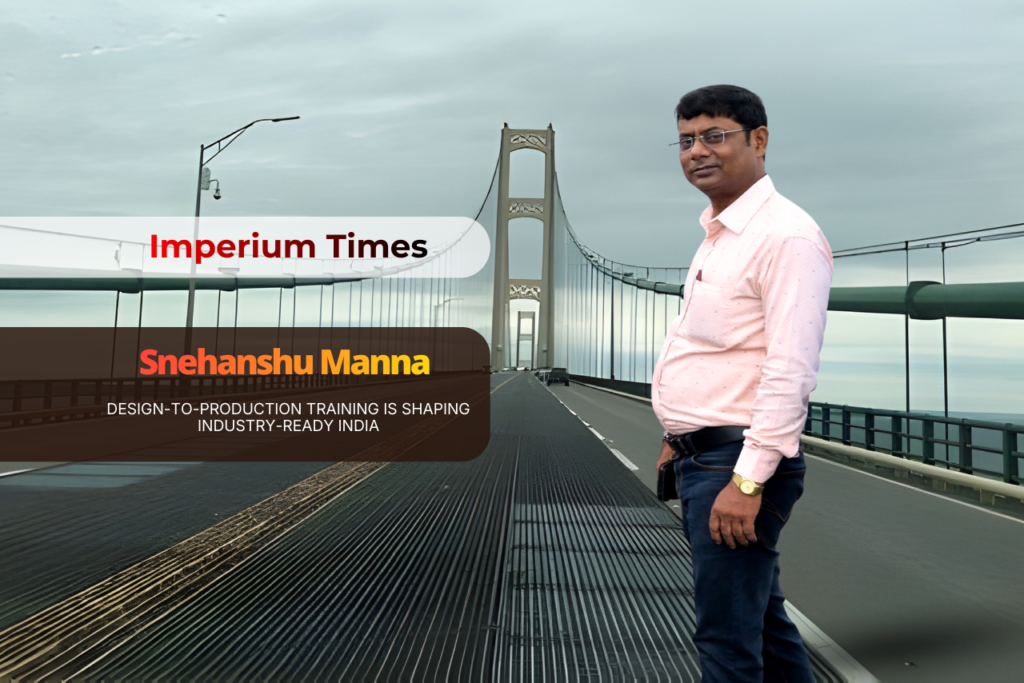
For decades, vocational education across India followed a segmented structure. Design was conceptualized in one space, execution occurred in another, and trainees were rarely exposed to the complete lifecycle of industrial production. This created a workforce proficient in operating machines, yet dependent on external inputs for planning, optimization, and problem-solving.
The pedagogical shift introduced at ITI Durgapur dismantles this fragmented approach. Trainees are now immersed in a complete design-to-production workflow that mirrors real industrial environments. The emphasis is not on repetition, but on understanding—how a component is conceived, modeled, optimized, and finally produced with precision.
This shift has elevated vocational training from task execution to technical architecture.
The Design-to-Production Framework Explained
At the core of this transformation lies an integrated methodology that synchronizes digital tools with traditional machining expertise. Students begin their learning journey not at the machine, but at the design stage.
1. Digital Conceptualization and 3D CAD Modeling
Trainees are trained to convert abstract concepts into accurate three-dimensional digital models using Computer-Aided Design software. This stage builds spatial intelligence, measurement accuracy, and visualization skills—capabilities once reserved for engineering graduates.
2. Material Estimation and Resource Optimization
Before any physical machining begins, students calculate precise material requirements through digital simulation. This step drastically reduces wastage, lowers production costs, and instills an industrial mindset focused on efficiency and sustainability.
3. CNC Machining and Precision Execution
The final phase involves translating digital designs into physical components using Computer Numerical Control machines. Here, trainees gain confidence in executing complex tasks independently, adhering to international tolerance and precision standards.
This end-to-end exposure ensures graduates are industry-ready from day one.
Alignment with National Industrial Missions
The methodology practiced at Government ITI Durgapur directly supports India’s flagship national initiatives. Under the Skill India Mission, the objective is not merely employment, but employability—producing workers capable of adapting to modern industrial ecosystems. Simultaneously, Make in India demands manufacturing excellence rooted in precision, efficiency, and global competitiveness.
By producing technicians who can design, plan, and execute independently, this training model strengthens India’s manufacturing backbone from the shop floor upward. It cultivates creators rather than dependents, aligning perfectly with the vision of Atmanirbhar Bharat.
Snehanshu Manna: Socio-Economic Transformation Through Technical Education
Beyond industrial relevance, this pedagogical model has generated significant socio-economic impact, particularly in rural and semi-urban regions of West Bengal. Snehanshu Manna said any trainees entering ITI Durgapur come from backgrounds with limited access to advanced technical exposure. The integrated training approach levels the playing field, enabling them to compete with graduates from elite urban institutions.
A particularly notable outcome has been the rise in female participation in traditionally male-dominated technical trades. Through persistent mentorship and skill-based confidence building, vocational training has emerged as a pathway to financial independence for young women. In regions where early marriage once curtailed professional aspirations, technical education now offers an alternative future defined by autonomy and career growth.
Sustainability Through Precision and Planning
Industrial sustainability is often discussed at the macro policy level, yet its real execution begins at the training stage. By emphasizing digital pre-modeling and material estimation, this methodology significantly reduces raw material waste during training and production.
Students internalize the principle that sustainability is not an abstract concept, but a measurable outcome of precision, planning, and accountability. This mindset prepares them for industries increasingly governed by environmental compliance and cost efficiency.
Snehanshu Manna,: Bridging the Skill Gap in Industry 4.0
One of the greatest challenges in technical education is the constant lag between curriculum updates and technological advancement. Machinery evolves faster than textbooks. To address this, the instructional approach adopted here emphasizes adaptability over static learning.
Students are trained to understand processes, not just procedures. This enables them to absorb new technologies—whether advanced CNC systems or automated production lines—without starting from scratch. The result is a workforce resilient to technological disruption.
Snehanshu Manna: The Educator Behind the Model
Snehanshu Manna, with over sixteen years of experience under the Directorate of Industrial Training, Technical Education Training and Skill Development Department, Government of West Bengal, Snehanshu Manna has emerged as a key architect of this transformation. His work demonstrates how instructional leadership, when combined with innovation, can redefine institutional outcomes and national capability.
Rather than teaching a trade in isolation, he has cultivated an ecosystem where learning mirrors real industry dynamics—complex, integrated, and demanding accountability at every stage.
Snehanshu Manna: A Blueprint for the Future of Vocational Training
Snehanshu Manna: As India positions itself for the next phase of industrial growth, the future of vocational education will depend on scalability of such models. The design-to-production framework implemented at ITI Durgapur offers a replicable blueprint for institutions across the country.
It proves that with the right methodology, government training institutes can produce globally competitive talent, foster social equity, and strengthen national manufacturing goals simultaneously.
Conclusion: Building Industrial Architects, Not Just Operators
The evolution of vocational education is no longer optional—it is essential. Snehanshu Manna is merging digital design, precision machining, sustainability, and social inclusion into a single instructional framework, this model has redefined what skill training can achieve.
As Industry 4.0 continues to reshape global manufacturing, India’s competitive edge will be determined by how effectively its workforce is prepared at the grassroots level. The transformation underway in West Bengal stands as a compelling example of how education, when aligned with industry and purpose, can build not just skilled workers—but architects of the nation’s industrial future.
Read More Articles like this: