
Indranil Mukherjee from Bankura, West Bengal | National Teachers Award 2025 | Utkarsha Bangla Excellence Award 2025
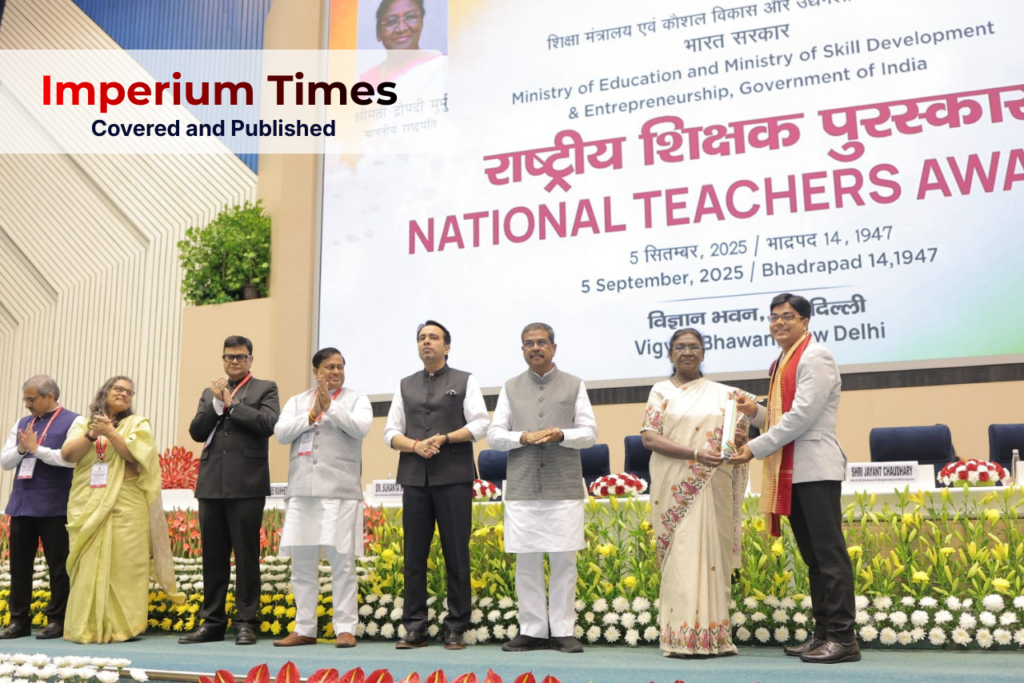
In an era where technology evolves faster than human discipline, and industry demands outpace traditional education systems, a rare kind of educator emerges—one who teaches machines, mentors minds, and molds character. That educator is Indranil Mukherjee, a nationally recognized instructor from Bankura, West Bengal, whose work under the Directorate of Industrial Training, Technical Education Training and Skill Development Department, Government of West Bengal, has reshaped how technical education is delivered, perceived, and lived.
Honored with the National Teachers Award 2025 and the Utkarsha Bangla Excellence Award 2025, the highest state recognition for excellence in skill training, his contributions extend far beyond classrooms. They influence curriculum design, green technology adoption, youth employability, and—most critically—the cognitive well-being of students navigating a hyper-digital world.
This is not merely a story of professional achievement. It is a narrative about responsibility, restraint, and redefining what it means to educate in the twenty-first century.
Indranil Mukherjee Teaching Beyond Tools: A Philosophy Rooted in Human Control
At the heart of Mukherjee’s educational philosophy lies a simple but radical belief: technology must serve the learner, not enslave them. In response to growing concerns around mobile phone addiction among students, he launched a nationwide awareness initiative built around a powerful declaration:
“I CAN SWITCH OFF MY MOBILE PHONE.”
This statement is not symbolic rhetoric. It is a behavioral framework designed to reintroduce self-control into a generation overwhelmed by screens, notifications, and dopamine-driven digital consumption. According to Mukherjee, unchecked mobile usage disrupts the biological clock of students, affecting sleep cycles, hormonal balance, emotional regulation, and long-term cognitive development.
He consistently warns that while smartphones are indispensable tools, their misuse erodes creativity, patience, and deep thinking—skills essential for technical professionals. His campaign urges students to reclaim authority over machines and re-engage with books, physical activity, workshops, and real-world problem solving.
Indranil Mukherjee: Reclaiming Cognitive Health in Technical Education
Modern vocational training cannot exist in isolation from mental and physical health. Excessive screen exposure, late-night scrolling, and dependency on short-form digital content have resulted in rising cases of insomnia, anxiety, vision impairment, and reduced attention spans among trainees.
Mukherjee’s approach addresses these challenges holistically. He promotes structured routines, disciplined technology use, and a return to foundational learning habits—reading technical manuals, hands-on experimentation, and collaborative discussion. By integrating wellness into pedagogy, he ensures students develop both technical competence and cognitive resilience.
Curriculum Innovation Aligned with Industry Reality
Beyond advocacy, Mukherjee has played a critical role in reshaping India’s technical training ecosystem. His contributions to the Craftsman Training Scheme (CTS) and Craftsman Instructor Training Scheme (CITS) have modernized automotive education across multiple disciplines, including:
- Mechanic Diesel
- Mechanic Motor Vehicle
- Two and Three-Wheeler Mechanic
By aligning syllabi with real-world industry standards, he has helped close the persistent gap between academic instruction and industrial application. Trainees emerging from these programs are not merely certified—they are employable, adaptable, and industry-ready.
Green Technology and the Future of Mobility
As India advances toward its Net Zero commitments, Indranil Mukherjee has proactively embedded sustainability into technical education. His instructional initiatives now include advanced modules on:
- Electric vehicle powertrains and battery management systems
- Hybrid vehicle diagnostics
- Alternative fuels such as CNG and hydrogen-cell technologies
This forward-looking integration ensures that students are prepared not only for current market needs but also for future disruptions in the automotive and mobility sectors. His work strongly supports national initiatives such as Skill India and Make in India, reinforcing India’s position in the global green mobility transition.
The Agile Educator in a Rapidly Changing World
One of the most defining aspects of Indranil Mukherjee’s work is his advocacy for adaptive pedagogy. He recognizes that formal curricula cannot be updated daily to match technological breakthroughs. Instead, he champions the concept of the “Agile Educator”—a professional who continuously upgrades skills, absorbs industry changes, and translates them into practical training modules.
By doing so, he transforms technical institutions into dynamic knowledge hubs rather than static syllabus centers. Students trained under this model are not constrained by textbooks; they are empowered by relevance.
Education with Purpose: Service Beyond Employment
Mukherjee’s philosophy extends beyond employability. His guiding principle—
“Enter to Learn and Exit to Serve.”
—redefines the role of technical education in society. This ethos reframes students not as job seekers but as skilled contributors capable of serving industries, communities, and the nation.
By instilling values of accountability, discipline, and social responsibility, he ensures that technical excellence is paired with ethical awareness. Graduates trained under this model carry not only certifications but also a sense of duty toward national development.
Indranil Mukherjee: National Recognition and Institutional Impact

The recognition conferred upon Indranil Mukherjee at Vigyan Bhawan by the Current Hon’ble President of India Mahamahim Droupadi Murmu underscores the national importance of his work. His dual honors—the National Teachers Award and the Utkarsha Bangla Excellence Award—validate his systemic impact on vocational education and skill development.
These accolades reflect more than individual achievement. They acknowledge the vital role instructors play in shaping India’s workforce, economy, and innovation capacity.
A Model for the Modern Indian Educator
In 2025 and beyond, education demands more than subject mastery. It requires foresight, empathy, adaptability, and courage to challenge unhealthy norms. Through curriculum innovation, green technology leadership, and cognitive wellness advocacy, Indranil Mukherjee represents the modern Indian educator—one who builds skills, safeguards minds, and strengthens society.
His work reminds us that the future of technical education is not just about machines and modules, but about humans who know when to switch on technology—and when to switch it off.