
London | Imperium Times Global Desk
Andy Burnham has officially stepped into 10 Downing Street as the United Kingdom’s new Prime Minister, becoming the seventh person to hold the office in just a decade. This rise marks one of the most closely watched political transitions in recent British history, arriving at a moment when the country is battling economic stagnation, a cost-of-living crisis, and a deep public trust deficit in Westminster. For millions of readers tracking global business and political shifts, the ascension of Andy Burnham is more than a domestic reshuffle — it is a signal that could ripple through markets, currencies, and international diplomacy for years to come.
From Manchester’s Mayor to Britain’s Top Job
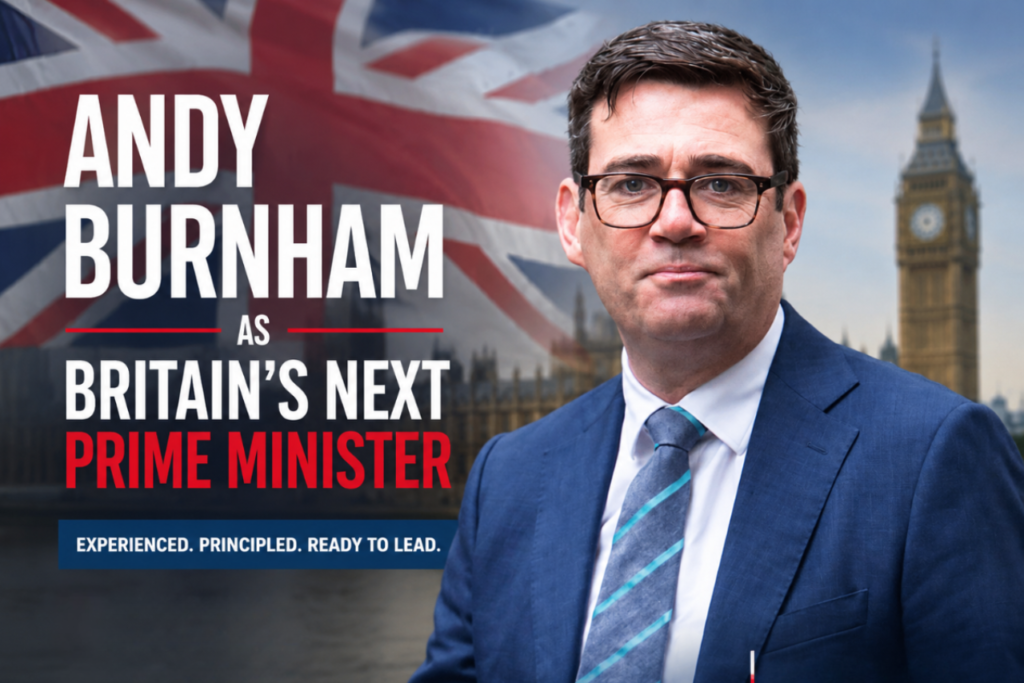
Before Monday, Andy Burnham was best known as the Mayor of Greater Manchester, a role he held for nearly a decade and one that earned him the nickname “King in the North.” Long before that, he served as a Labour Member of Parliament and held cabinet positions under former Prime Ministers Tony Blair and Gordon Brown. That deep institutional experience is precisely why many within the Labour Party viewed Andy Burnham as the natural successor once outgoing Prime Minister Keir Starmer agreed to step aside following a punishing run of election defeats, policy reversals, and scandals.
Andy Burnham was elected unopposed as the new leader of the Labour Party last week, clearing the path for his formal appointment. On Monday morning, Starmer addressed the press outside Downing Street one final time, saying his work was “done” and that he was proud of what his government had achieved. He then travelled to Buckingham Palace to tender his resignation to King Charles III. Shortly after, he made the same journey, where the monarch formally invited him to form a new government — a constitutional formality that cleared the way for Andy Burnham’s premiership to begin immediately.
“A Circuit Breaker” — Burnham’s First Address as Prime Minister
Standing outside Downing Street for the first time as Prime Minister, Andy Burnham did not mince words about the scale of the challenge ahead. He described his appointment as a chance to be “a circuit-breaker” for a country exhausted by revolving-door leadership and economic drift. He promised to build a new political and economic model anchored by a ten-year national plan, pledging greater public-sector control over essential goods and services so that prices could be brought back “within reach of ordinary households.”
He also used government procurement as a centerpiece of his economic pitch, vowing that public contracts would increasingly favour domestic industry as part of a broader push to reindustrialise the UK. Beyond economics, he promised to end rough sleeping nationwide and reaffirmed Britain’s defence commitments to its international allies, seeking to reassure both voters and foreign partners that continuity on security matters would not be sacrificed amid the domestic upheaval.
Markets, Bonds, and the Burnham Effect
Financial markets had been anxious about this moment for months. Investors in UK government bonds, known as gilts, had broadly favoured continuity under Starmer and his finance minister because of their commitment to disciplined public borrowing. Andy Burnham is widely seen as sitting to the left of Starmer, and the prospect of his leadership had earlier sent jitters through bond markets. Yet on his first full day in office, the reaction from traders was notably muted rather than alarmed, suggesting markets are adopting a wait-and-watch approach toward his still-unfolding policy agenda.
That caution is likely to persist until Andy Burnham reveals more specifics of his ten-year plan, particularly around spending commitments, borrowing limits, and how his pledge for “public-sector control over essential goods” will be implemented without spooking bondholders further. Analysts tracking the pound and UK equities will be watching closely for any signals from the new administration in the coming weeks.
Cabinet Shake-Up Follows the Historic Handover
The transition was not limited to the top job. Later on Monday, several senior figures confirmed their departure from government, including the outgoing deputy prime minister and the finance minister who had overseen fiscal policy under Starmer. Such a sweeping cabinet exit alongside a leadership change underscores how comprehensively Andy Burnham intends to reshape the direction of his government from day one, rather than simply inheriting his predecessor’s team and priorities.
Political observers note that the scale of this reshuffle gives Andy Burnham considerable room to install allies who share his more interventionist economic instincts, potentially accelerating the rollout of his stated priorities around cost-of-living relief and industrial policy.
Trump Weighs In, Praising and Provoking in the Same Breath
The international reaction to Andy Burnham’s rise has been anything but quiet. US President Donald Trump publicly welcomed one specific element of the new Prime Minister’s agenda: a plan to fast-track oil and gas exploration in the North Sea. Trump praised the move on social media, suggesting it would benefit communities like Aberdeen in Scotland. However, Trump has also been sharply critical of Britain’s broader economic condition elsewhere in his commentary, a mixed message that captures just how polarising international opinion on Andy Burnham’s Britain has already become, even in his first days in charge.
Global leaders, meanwhile, have been extending congratulations to Andy Burnham following his confirmation, a customary diplomatic step that nonetheless signals how closely allied nations will be monitoring the UK’s next moves on trade, defence, and energy policy under its newest leader.
Why This Matters Beyond Britain’s Borders
For a global business audience, the emergence of Andy Burnham as Prime Minister is significant well beyond Westminster politics. The UK remains one of the world’s largest economies and a key financial hub, meaning any shift in fiscal direction under his leadership has consequences for currency markets, international investors, and multinational companies with UK operations. A government leaning into public-sector intervention and domestic industrial support could reshape everything from energy contracts to public procurement bids for years to come.
Additionally, the North Sea oil and gas fast-tracking plan championed by Andy Burnham could reposition the UK’s energy strategy at a moment when European economies are grappling with rising energy costs and climate commitments simultaneously. How he balances industrial revival with environmental pledges will be one of the most-watched policy tightropes of his tenure.
The Road Ahead for Andy Burnham
Andy Burnham inherits a nation weary of instability — seven Prime Ministers in ten years is an extraordinary churn rate for any G7 democracy. His promise to “regain stability” will be tested almost immediately, not just by markets and political rivals, but by an electorate that has grown skeptical of grand promises following a decade of unmet expectations from Westminster.
Whether Andy Burnham can convert his early goodwill, symbolic cabinet reshuffle, and populist economic messaging into durable results remains the defining question of his premiership. What is clear is that his ascension represents one of the most consequential leadership changes in recent British political history, and the coming months will reveal whether the “circuit breaker” he promised can genuinely reset the UK’s trajectory — or whether Andy Burnham becomes merely the latest name in a long list of short-lived British premierships.
Source: Imperium Times
Frequently Asked Questions
Who is Andy Burnham? Andy Burnham is the newly appointed Prime Minister of the United Kingdom, previously serving as Mayor of Greater Manchester and as a Labour cabinet minister under Tony Blair and Gordon Brown.
When did Andy Burnham become Prime Minister? Andy Burnham was formally appointed Prime Minister on Monday, July 20, 2026, after King Charles III invited him to form a government.
Who did Andy Burnham replace as Prime Minister? Andy Burnham succeeded Sir Keir Starmer, who resigned after a series of election setbacks and falling public support.
What is Andy Burnham’s economic plan? Andy Burnham has pledged a ten-year national plan focused on public-sector support for essential goods, domestic industrial procurement, and cost-of-living relief for ordinary households.
Read More Articles Like this at Imperium Times